
Conservation Status
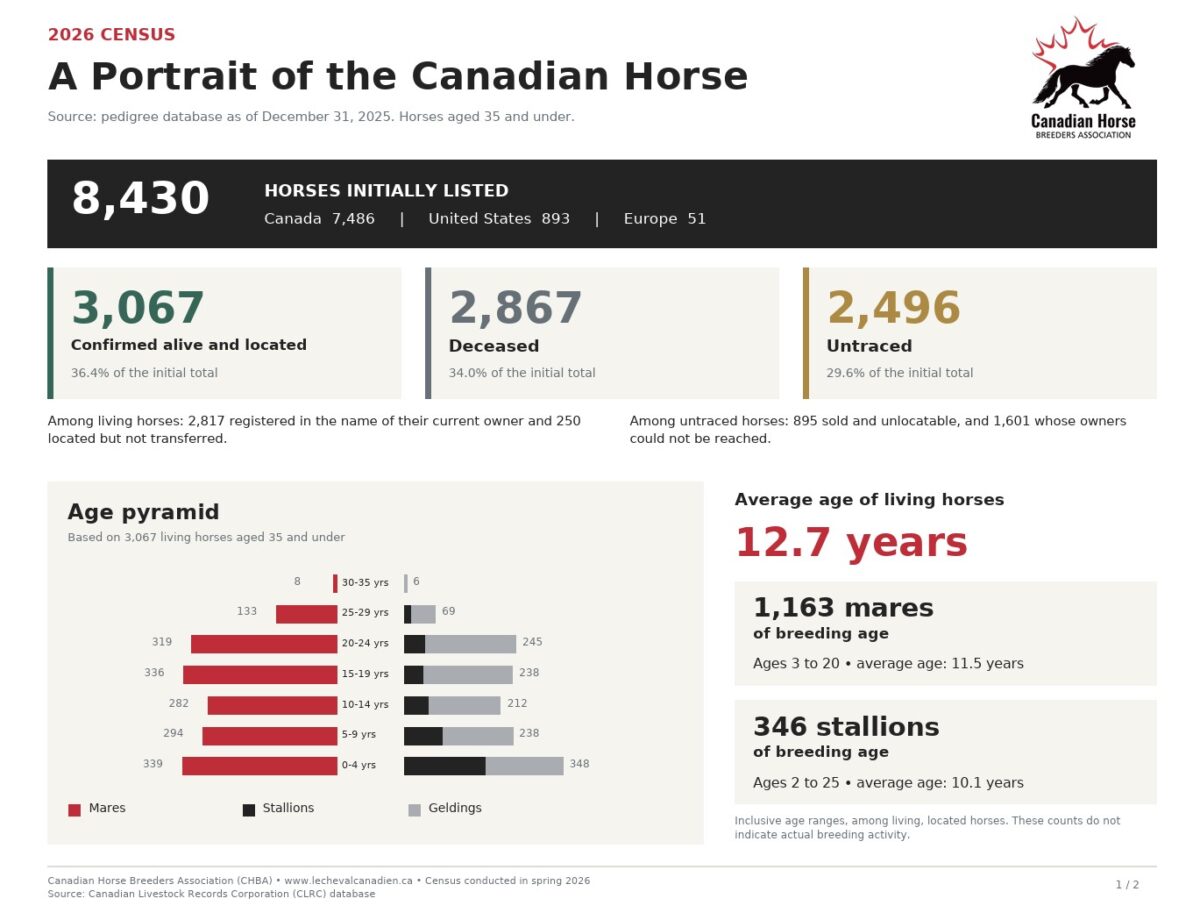
The 2026 Census: A Portrait of the Canadian Horse, conducted in spring 2026 by the Canadian Horse Breeders Association (CHBA) using Canadian Livestock Records Corporation (CLRC) data (covering horses aged 35 and under as of December 31, 2025), provides the following breakdown of the breed’s global population and conservation status:
Overall Population Status (Out of 8,430 Initially Listed Horses)
-
Confirmed Alive & Located: 3,067 horses (36.4%) — 2,817 are registered to their current owners, while 250 were located without an official ownership transfer.
-
Deceased: 2,867 horses (34.0%) — Includes horses officially reported dead and untraced horses aged 25 and older.
-
Untraced: 2,496 horses (29.6%) — Horses under age 25 whose status could not be confirmed (1,601 had unreachable owners; 895 were sold and could not be located).
Demographics & Breeding Potential (Among the 3,067 Living Horses)
-
Average Age: 12.7 years
-
Breeding-Age Mares (Ages 3–20): 1,163 mares (average age: 11.5 years)
-
Breeding-Age Stallions (Ages 2–25): 346 stallions (average age: 10.1 years)
-
Age Distribution: The living population is fairly evenly spread across age brackets from 0–24 years (roughly 494 to 687 horses per 5-year bracket), with numbers dropping significantly after age 25 (202 horses aged 25–29, and just 14 aged 30–35). Notably, intact stallions make up a very small fraction of each age group compared to mares and geldings.
Geographic Distribution of Living Horses
-
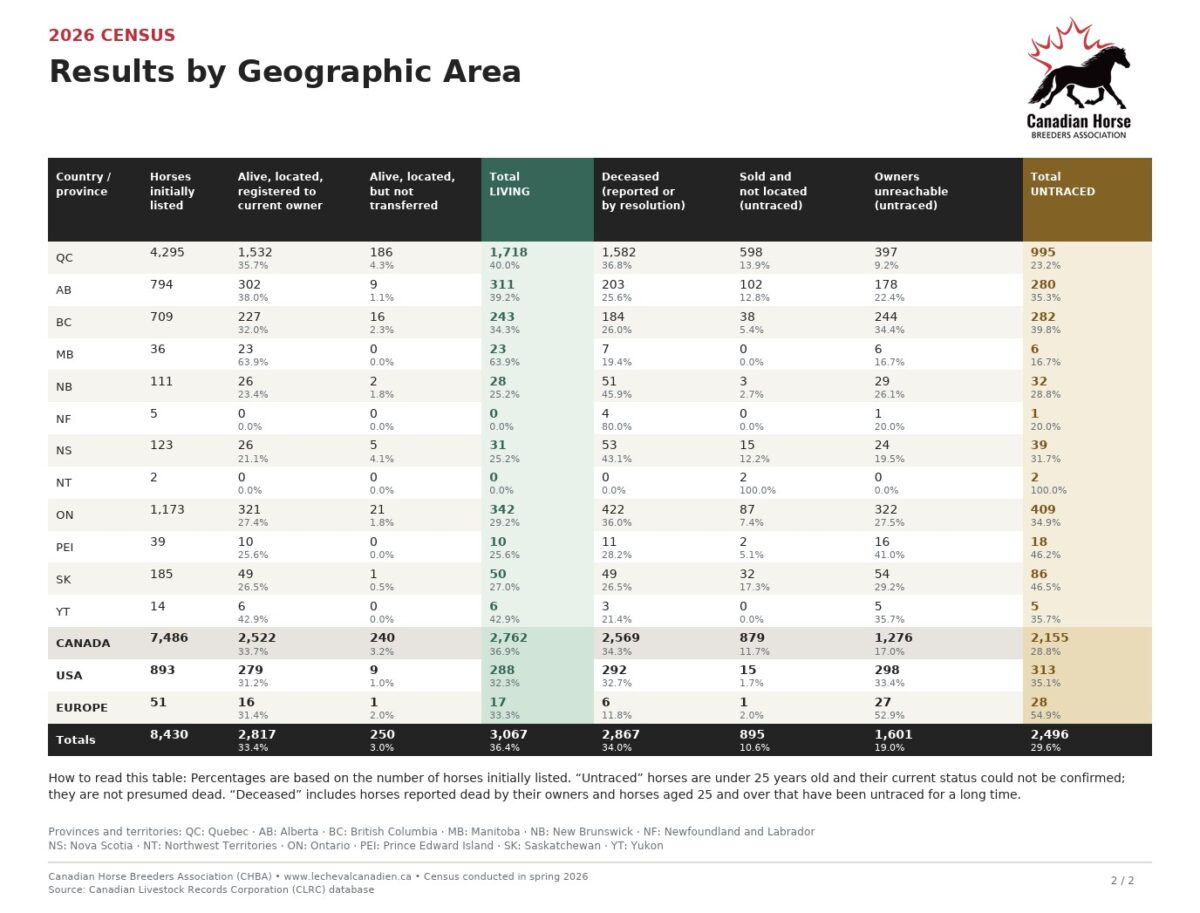
Canada (Total: 2,762 living out of 7,486 listed | 36.9%):
-
Quebec: 1,718 living (62% of all living Canadian Horses worldwide)
-
Ontario: 342 living
-
Alberta: 311 living
-
British Columbia: 243 living (with 282 untraced)
-
Saskatchewan: 50 living
-
Atlantic Canada: 69 living total (31 in Nova Scotia, 28 in New Brunswick, 10 in PEI, 0 in Newfoundland & Labrador)
-
Manitoba: 23 living
-
Territories: 6 living in Yukon, 0 in Northwest Territories
-
-
United States: 288 living out of 893 listed (32.3%), with 313 untraced.
-
Europe: 17 living out of 51 listed (33.3%), with 28 untraced.
Key Conservation Takeaways
Nearly 30% of the breed’s registered population under age 25 is currently untraced, and another 250 living horses have unrecorded ownership transfers. Additionally, while over 1,500 horses fall within breeding-age brackets, the census notes that these figures reflect age eligibility rather than active breeding, underscoring the importance of tracking ownership and utilizing intact breeding stock.
30 WAYS TO SUPPORT THE CANADIAN HORSE
Written by Sanda Allen, November 2026
First posted on the Canadian Horse CHBA/SECC Facebook page.
Reprinted with her permission
Here is a refresher on 30 ways to help preserve and support the Canadian Horse breed. Thank you to everyone doing any of these things already. Please share more ideas so we can all pitch-in.
-
Buy or Lease a Canadian Horse: The single most effective way to save a heritage livestock breed is to create sustainable market demand. Purchasing from reputable breeders proves there is an active market, giving them the financial viability to produce the next generation. That being said, some of us need to open NEW markets. I am personally trying to push towards endurance and working equitation but many other fields should be explored. Big question here though: should we sell our fillies and mares to riding only homes? In other words, to people who don’t plan on breeding? Breeders do need to survive financially otherwise no breeders… no breed. So what “should” we do? Not sure just selling geldings would support breeders enough. However, no mares, no breed.
-
Register Every Foal and Transfer Ownership: For an endangered breed, unrecorded horses are genetically invisible. Register every purebred foal with the Canadian Livestock Records Corporation (CLRC), and file transfer papers immediately whenever a horse changes hands so conservationists can accurately track active bloodlines.
-
Breed Purebred and Choose Underrepresented Bloodlines: While crossbreeding produces talented sport horses, it does not replenish the purebred gene pool. Prioritize purebred pairings and consult breed registries and conservation breeding guides to match horses with lower kinship coefficients rather than relying solely on the most popular sires.
-
Keep Stallions Intact Longer (or Consider Co-Ownership): Gelding promising young colts too early permanently narrows the breed’s genetic base. Experienced horsemen can keep well-conformed, genetically distinct colts intact until they are evaluated for breeding, or enter stallion syndicates to share the cost of standing a stallion at stud. Learning to work as a team could be beneficial long term.
-
Contribute to Equine Gene Banks: Cryopreservation acts as an insurance policy against sudden population drops or disease outbreaks. Stallion owners can collect and store frozen semen through organizations like Heritage Livestock Canada or regional veterinary programs, preserving rare sire lines for decades. We could fundraise for this and offer frozen and fresh semen at a reduced cost thereby helping isolated breeders. Let’s party for a cause?
-
Participate in Genetic and Health Research: Conservation geneticists rely on accurate DNA data to monitor inbreeding levels and identify hereditary traits. Owners can contribute hair follicle or blood samples when universities or breed associations conduct genetic diversity studies. We need more of this. Let’s mobilize a science squad. This is one of many areas where participants don’t even need to own a horse.
-
Offer Mare-Leasing Agreements: Many quality purebred mares sit unbred in recreational homes while experienced breeders lack enough broodmares to expand their programs. Leasing an unbred, registered mare to a reputable breeder for a season or two gives them access to valuable maternal bloodlines without the upfront cost of buying another horse.
-
Invest in Cooled or Frozen Semen Infrastructure: Shipping fresh-cooled semen across North America gives breeders access to diverse stallions without hauling mares long distances. Equine veterinarians, reproduction clinics, and private donors can subsidize stallion collection fees, donate shipping containers (Equitainers), or establish regional breeding hubs. This can be done with number 5 (party for a cause fundraising).
-
Fund Genetic Diversity & Pedigree Analysis Tools: Selecting pairings that protect all eight traditional stallion lines and six maternal lineages requires detailed pedigree data. Donors, programmers, or equine science students can help maintain and upgrade online pedigree databases, kinship calculators, and DNA parentage testing subsidies. We have a good start on this (CLRC) but we can do more. Mobilize a “Geek Squad”?
-
Offer Pasture or Boarding Space to Breeders: Land and hay costs are major barriers preventing breeders from keeping broodmares or growing out young stock. Landowners can lease pasture at a reduced rate to a reputable breeder or offer affordable board for weaning colts until maturity. Co-owning or just being a foster home for Canadian horses helps lessen the burden. One person can’t do it all but we can all do something.
-
Provide Subsidized Hay, Grain, or Farrier Barters: Feed and hoof care are a breeder’s largest recurring expenses while raising young stock for two to three years. Local hay farmers, farriers, and equine bodyworkers can help by offering bulk discounts, deferred winter payment plans, or work-trade arrangements. We need a list of available trainers and a list of trainers willing to take untrained horses on a sales commission contract. Many breeders would benefit from a consignment situation however many just don’t know where to find those services. Consequence: young prospects stay untrained in the fields. Sometimes that means unsold. Thank goodness for Canadian Horse Link and the various Facebook groups. We have a good start but we need to help breeders who are off the internet more. Helping them helps the breed.
-
Buy Weanlings or Yearlings (“Foals in Utero” Contracts): Waiting three to four years to train and sell a young horse ties up a breeder’s stall space and capital. Experienced horsepeople can ease that bottleneck by purchasing weanlings, yearlings, or contracting for a foal in utero-providing immediate cash flow and freeing up pasture for next year’s foal crop.
-
Assist with Professional Foal Imprinting and Groundwork: A well-handled youngster sells faster and for a higher price than an untouched pasture colt, yet small breeders often lack the hours to handle every foal daily. Trainers and skilled handlers can volunteer to teach basic halter manners, trailer loading and farrier prep. You don’t need to own a horse to volunteer with a breeder. Just contact them directly. Even if it’s just brushing, every little bit helps.
-
Help Breeders with Modern Digital Marketing: Many small-scale heritage breeders are skilled horse people who lack the time or technical background to market foals online. Volunteering photography, videography, website design, or social media management helps breeders reach serious buyers across North America.
-
Help Breeders Navigate Agricultural Grants and Tax Status: Small heritage breeders sometimes miss out on agricultural tax exemptions, environmental farm grants, or rare-breed subsidies due to paperwork hurdles. Accountants, grant writers, and agricultural extension volunteers can help breeders structure their operations as recognized farm businesses.
-
Coordinate Shared Long-Distance Hauling: Geographic distance is a major hurdle across North America. Organizing “ride-share” hauling networks among breeders and owners reduces per-horse shipping expenses for breeding trips, sales deliveries, and national breed shows. I started a Canadian ride-share group on Facebook but we need more.
-
Provide Foaling Watch and Emergency Barn Coverage: Breeding season is grueling, and many small-scale breeders work full-time off the farm while managing pregnant mares alone. Trusted neighbors and experienced horse friends can offer overnight foaling-watch shifts, install barn camera systems, or cover weekend chores to prevent breeder burnout.
-
Foster, Haul, or Adopt Through Breed-Specific Rescues: Because the breed is uncommon, Canadian Horses occasionally end up in livestock auctions unrecognized by general buyers. You can volunteer as an auction spotter, offer trailer transport, provide temporary foster care, or adopt through charities such as the Canadian Horse Rescue and Re-Homing Society.
-
Join and Fund Breed Conservation Organizations: Membership dues and donations directly fund breed promotion, youth incentives, and genetic research. Support groups working on the ground, including La Société des Éleveurs de chevaux Canadiens / Canadian Horse Breeders Association (SECC/CHBA), the Canadian Horse Heritage & Preservation Society (CHHAPS), Heritage Livestock Canada, and The Livestock Conservancy (for U.S. enthusiasts).
-
Sponsor Stallion Service Auctions: Breed associations and preservation societies often run annual stallion service auctions to raise conservation funds while keeping stud fees accessible. You can help by organizing the online auction platform, donating promotional packages for participating stallions, or bidding on a breeding.
-
Include Heritage Livestock Charities in Estate or Planned Giving: Long-term conservation requires stable funding that outlasts single breeding seasons. Designating a legacy gift, endowment contribution, or equine care trust to a registered Canadian Horse preservation charity ensures ongoing resources for rescues, genetic banking, and breeder grants.
-
Showcase the Breed in Public and Competition: Entering registered Canadians in “all-breed” dressage, hunter-jumper, driving, eventing, endurance, working equitation, western events, public parades, trail riding, pack trips or equine expos as well as enrolling in breed-specific recognition programs like the CHHAPS Versatility and Award Programs, proves that they are capable modern sport and leisure partners. Every ambassador counts. This is personally where I make an exception in regards to mares. If they help the breed through promotion… I personally feel it’s ok for them not to be bred however I understand many may disagree with me. And that’s ok. Just remember… One amazing ambassador could help sell 200 foals or more in its lifetime. Food for thought.
-
Sponsor Breed Classes and Perpetual Trophies at Local Shows: Many regional agricultural fairs and open horse shows drop heritage breed classes when entry numbers or prize funds dip. Individuals, businesses, or riding clubs can sponsor a Canadian Horse halter or performance division to keep the breed visible in the show ring. Endurance events for example can give a special award for the best Canadian horse in the event. Most all-breed events “could” do this if there are enough participants. Our breed associations should also give out trophies, awards or certificates as long as the numbers justify it. I volunteer to do this for any association as long as I can. I would enjoy this type of volunteer work. I have a magic number that comes to mind: “5” participants in an all-breed event. Just an idea. To be discussed… Thank you to all the associations who already do this. Keep up the great work. And please keep bragging about our wonderful ambassadors. It helps the whole breed.
-
Support Youth and 4-H Heritage Initiatives: Passing horsemanship and breed awareness to younger generations is essential for long-term survival. Sponsor a local 4-H rider, lease a steady Canadian gelding to a junior equestrian, or help youth access grants-such as Heritage Livestock Canada’s 4-H heritage breed incentive to exhibit at county fairs. What I said in number 23 applies here too.
-
Use Canadian Horses in Therapeutic Riding and Lesson Programs: Their calm disposition, sturdy build, and smooth gaits make Canadian Horses ideal for equine-assisted therapy and beginner lesson barns. Recommending the breed to local riding centers-or donating a trained gelding to a therapeutic program-gives hundreds of new riders positive firsthand experience.
-
Create “Trial” or Share-Boarding Opportunities: Prospective buyers sometimes hesitate to commit to a rare breed they have never ridden or driven. If you own a reliable Canadian Horse, offering a part-lease or supervised trail ride to an experienced equestrian lets them experience the breed’s temperament and work ethic in person.
-
Partner with Living History Sites and Eco-Tourism Operators: Historical villages, heritage farms, and carriage tour companies rely on authentic, hardy animals. Encouraging local museums, parks, or trail-riding outfitters to feature Canadian Horses creates steady institutional demand and introduces the breed to thousands of visitors annually.
-
Support Sustainable Forestry and Small-Scale Farming Uses: Originally bred as versatile homestead animals capable of pulling logs and working fields, Canadian Horses excel in low-impact logging, market gardening, and draft-horse workshops-highlighting their practical value in modern regenerative agriculture.
-
Organize Regional Trail Rides or Breed Meetups: Where Canadian Horses are scattered across distant farms, owners can feel isolated. Hosting an annual trail ride, driving clinic, or casual barn open house connects owners, encourages mentorship for first-time breeders, and draws curious spectators.
-
Educate and Advocate Within Your Local Horse Community: Share the breed’s history-from its roots in the royal stables of King Louis XIV in 1665 to its foundational influence on the Morgan, Standardbred, and Tennessee Walking Horse. Writing articles, sharing accurate breed profiles online, and introducing fellow boarders to your horse turns casual admirers into future owners. We need free education for all breeders and potential future breeders.